Sep 22, 2026
How to Spot Fake Followers on Instagram (7 Red Flags)
Learn how to spot fake Instagram followers in 30 seconds with 7 red flags. Free checker + manual methods to verify influencer authenticity before spending.
 Sophie Klein2,365 words10 min read
The best way to spot fake followers on Instagram is checking engagement rate (should be >2%), follower profile quality, and comment authenticity—all visible in 30 seconds. Here's the exact checklist brands use before signing $5K+ influencer deals.
Last Tuesday, a DTC skincare brand nearly wasted $8,000 on an influencer partnership. The account had 120K followers and picture-perfect content. But when their marketing manager ran a quick authenticity check, she discovered something alarming: 68% of the followers were bot accounts from Indonesia and Turkey. The brand's target market? Women aged 25-40 in the United States.
This isn't rare. Research shows 49% of influencers have at least 15% fake or inactive followers in their audience. For cross-border DTC brands operating on tight budgets, one bad partnership can burn an entire quarter's influencer marketing spend.
The problem got worse in 2026. AI-generated bot accounts now use realistic profile photos, mimic human behavior, and even leave semi-coherent comments. The old red flags—no profile picture, zero posts, random usernames—don't catch them anymore.
This guide teaches you the 7 red flags that still work in 2026, plus a 5-minute vetting workflow marketing teams use to screen 100+ influencer candidates. You'll learn both manual identification methods and tool-assisted verification so you can confidently spot fake followers before signing any deal.
Want to check an account's follower authenticity in 30 seconds? Try CreatiVault's free Instagram fake follower checker—no sign-up required, unlimited checks.

Key Takeaways
• Engagement rate below 2% is a major red flag; healthy accounts maintain 2-5% for micro-influencers, 1-3% for macro
• AI-generated bot accounts now use realistic photos and usernames—check for "too perfect" faces and generic bios instead
• Story views should be 5-15% of follower count; anything below 5% indicates a fake follower problem
• Geographic mismatch is the easiest tell: US-focused creator with 70% followers from Southeast Asia or South America
• Use a combination of manual checks (7 red flags) + automated tools for fastest, most accurate vetting
What Are Fake Followers? (And Why They're Everywhere)
Fake followers fall into three categories: bot accounts (automated scripts), inactive accounts (real users who abandoned Instagram), and purchased followers (bulk-bought from services).
They're everywhere because buying followers is cheap and easy. Services sell 1,000 followers for $10-30, or 10,000 for $50-150. For influencers chasing brand deals, inflated follower counts create the illusion of reach.
The 2026 twist? AI-generated bots are harder to detect. Instead of obvious "user12345678" usernames and blank profiles, modern bots use AI-generated faces (trained on StyleGAN), steal bio text from real accounts, and even repost content to look active. Traditional red flags miss them.
That's why brands need updated detection methods.
7 Red Flags to Spot Fake Followers
🚩 Red Flag #1: Sudden Follower Spikes
Normal Instagram growth is steady. An account gains followers gradually as content reaches new audiences through hashtags, Explore page, or Reels recommendations.
Fake follower purchases create visible spikes. An account jumps from 12K to 22K overnight, then growth flatlines for weeks.
How to check: Use Social Blade or scroll through the account's posting history. If follower count jumped 5K+ between two posts published days apart, that's purchased growth.
Real example: A fitness influencer went from 15K to 28K followers in 48 hours in March 2026. Her content quality hadn't changed. Her engagement rate dropped from 4.2% to 1.8% immediately after. Clear bot purchase.
CreatiVault Insight: Our Instagram Fake Follower Checker shows growth curves over 30/60/90 days. Legitimate accounts show consistent upward trends with minor dips. Bot-inflated accounts show sharp vertical spikes followed by plateaus or declines (as Instagram purges fake accounts).
🚩 Red Flag #2: Low Engagement Rate
Engagement rate is the single most reliable fake follower indicator. It's calculated as:
Engagement Rate = (Likes + Comments) / Followers × 100
Industry benchmarks (2026):
- Nano influencers (1K-10K): 4-8%
- Micro influencers (10K-100K): 2-5%
- Macro influencers (100K-1M): 1-3%
- Mega influencers (1M+): 0.5-2%
If a 50K-follower account consistently gets under 1,000 likes (2% engagement), that's suspicious. If it's under 500 likes (<1%), it's almost certainly bot-inflated.
The trap to watch for: High likes but zero comments. Some bot services only provide "like bots" because they're cheaper. An account with 5,000 likes but 8 comments screams fake engagement.
When Marcus, a DTC brand owner, vetted a potential partnership in June 2026, he found an influencer with 85K followers averaging 800 likes and 12 comments per post. That's 0.96% engagement—well below the 1-3% benchmark for that follower tier. He passed. Two months later, Instagram purged 40K fake followers from that account.

🚩 Red Flag #3: Suspicious Follower Profiles
You can't check all 50,000 followers, but you can sample 20-30. Click into the account's follower list and scroll through. Look for these bot characteristics:
Classic bot red flags (still work for 40% of fakes):
- No profile photo or default avatar
- Random alphanumeric usernames like "user47291" or "sarah_8374629"
- Zero posts or only 1-2 old posts
- Following 2,000+ accounts but have 50 followers (bot behavior)
- Bio completely empty or filled with random emoji
2026 AI bot red flags (newer, harder to spot):
- Profile photo looks "too perfect"—AI-generated faces have unnatural symmetry and overly smooth skin
- Generic bio stolen from real accounts ("Living my best life 🌟 | Coffee addict ☕")
- Account created recently (check join date if visible via third-party tools)
- Posts are all reposts/memes with no original content
Quick check method: Click on 10 random followers. If more than 3-4 match the patterns above, the account likely has a bot problem.
🚩 Red Flag #4: Generic, Bot-Like Comments
Real followers leave specific comments. Fake followers leave generic praise that could apply to any post.
Typical bot comments:
- "Nice!" / "Amazing!" / "Love this!"
- Emoji-only: "😍😍😍" or "🔥🔥🔥"
- "Great post!" / "Keep it up!" / "So good!"
- Single-word reactions: "Beautiful!" / "Perfect!" / "Wow!"
Real human comments:
- Ask questions: "Where did you get that jacket?"
- Reference specific content: "The tip about lighting in the third slide saved my Reels!"
- Share personal stories: "I tried this recipe last week and my kids loved it"
- Tag friends: "@jessica we should try this place"
How to check: Open the most recent 5 posts. Read 10-15 comments on each. If more than half are generic single-word responses or emoji spam, the engagement is bot-driven.
Red flag combo: High comment count but all generic. Some bot services provide comment bots to inflate engagement metrics. An account with 200 comments per post but 180 of them say "Nice!" or "🔥" is buying engagement.
🚩 Red Flag #5: Follower Geography Mismatch
Instagram's algorithm shows content to people in the creator's target market. A US-based beauty influencer posting in English should have 60-80% of followers from English-speaking countries (US, UK, Canada, Australia).
Geographic red flags:
- US-focused creator with 70% followers from Indonesia, Brazil, Turkey, or India
- English content but follower base is 80% non-English-speaking countries
- No clear reason for the mismatch (e.g., not a travel influencer, no international brand partnerships)
Why does this happen? Bulk follower services source bots from countries where labor and server costs are low. The purchased followers cluster in specific regions.
Example case: A fashion micro-influencer based in New York had 45K followers. Her content targeted US women aged 20-35. When a DTC apparel brand checked her follower demographics (using a tool that analyzes public data), they found 62% of followers were from Southeast Asia and the Middle East. The brand passed on the partnership. Geographic mismatch is the easiest red flag to verify and the hardest for fake accounts to mask.
Exception to watch for: Cross-border influencers who legitimately appeal to multiple markets. A K-pop content creator will have followers across Asia, North America, and Europe. That's organic, not fake.
How to check: Tools like CreatiVault's Influencer Scout or HypeAuditor show follower location breakdowns. For free manual checking, look at comments—if 80% of commenters have usernames and profiles from one non-target region, that's a red flag.

🚩 Red Flag #6: Story Views vs Follower Count
Instagram Stories are harder to fake than feed posts. Bots don't watch Stories consistently because it requires more sophisticated scripting.
Healthy ratio: Story views should be 5-15% of follower count.
- 50K followers → expect 2,500-7,500 Story views
- 10K followers → expect 500-1,500 Story views
Suspicious signals:
- 50K followers but only 800 Story views (1.6%)—likely 40K+ fake followers
- Story views consistently below 3% of follower count
- Story engagement (replies, poll votes) even lower than views
Story views are an Instagram-specific metric that cuts through fake follower inflation. A bot-heavy account can fake likes and comments on feed posts, but Story view counts expose the real active audience size.
When Sarah, an influencer marketing manager at a supplement brand, vetted a fitness influencer in August 2026, she noticed 78K followers but Story views averaging 1,200 (1.5%). She used CreatiVault's checker and confirmed: 64% fake follower rate. The real engaged audience was closer to 28K, not 78K.
Ready to verify Story view ratios before your next campaign? Run a quick check with CreatiVault's free tool—it calculates healthy benchmarks for any account size.
🚩 Red Flag #7: Reel Performance Anomaly
Instagram's 2026 algorithm heavily favors Reels. When you post a Reel, Instagram shows it beyond your follower base—to Explore pages, hashtag feeds, and recommended content streams.
Normal Reel performance: Views = Followers × 1.5 to 3x (sometimes higher for viral content)
- 50K followers → expect 75K-150K+ Reel views
- 10K followers → expect 15K-30K+ Reel views
Fake follower red flag: Reel views significantly below follower count
- 50K followers but Reels only get 5K-8K views
- Reels consistently underperform compared to follower count
Why does this happen? Fake followers don't watch Reels. Instagram's algorithm detects low engagement from the "follower" base and limits distribution. The account loses algorithmic reach.
How to check: Scroll through the last 5-10 Reels. Compare average Reel views to follower count. If Reels get fewer views than the follower count (not even 1x), the account is bot-heavy.
Reels are the hardest metric to fake in 2026. That's why they're the most reliable authenticity check.
How to Vet Influencers in 5 Minutes (Step-by-Step Workflow)
Marketing teams don't have time to deep-dive every candidate. Here's the 5-minute screening process agencies use to vet 100+ influencers per campaign:
Step 1: Quick Scan (30 seconds)
- Open the profile
- Check follower count vs recent post likes
- Mental math: If 50K followers and posts get 800 likes, engagement is ~1.6% (borderline suspicious)
Step 2: Tool Verification (1 minute)
- Run the account through CreatiVault's Instagram Fake Follower Checker
- Get instant metrics: fake follower percentage, engagement rate, follower quality score
- Decision thresholds:
- <15% fake followers → Pass to next round
- 15-25% fake followers → Manual investigation needed
- >25% fake followers → Reject
Step 3: Manual Spot Check (2 minutes)
- Click into follower list, scan 20 profiles
- Count how many look like bots (no photo, random username, zero posts)
- Open last 5 posts, read 10 comments each
- Check for generic bot comments vs real engagement
Step 4: Story/Reel Cross-Check (1 minute)
- Check most recent Story view count (if available via screenshot or tool)
- Calculate: Story views / Followers × 100 (should be 5-15%)
- Scroll Reels, compare views to follower count
Step 5: Decision (30 seconds)
Criteria | ✅ Pass | ⚠️ Investigate | ❌ Reject |
|---|---|---|---|
Fake follower rate | <15% | 15-25% | >25% |
Engagement rate | >2% | 1-2% | <1% |
Comment quality | Mostly real | Mixed | Mostly generic |
Story views ratio | 5-15% | 3-5% |
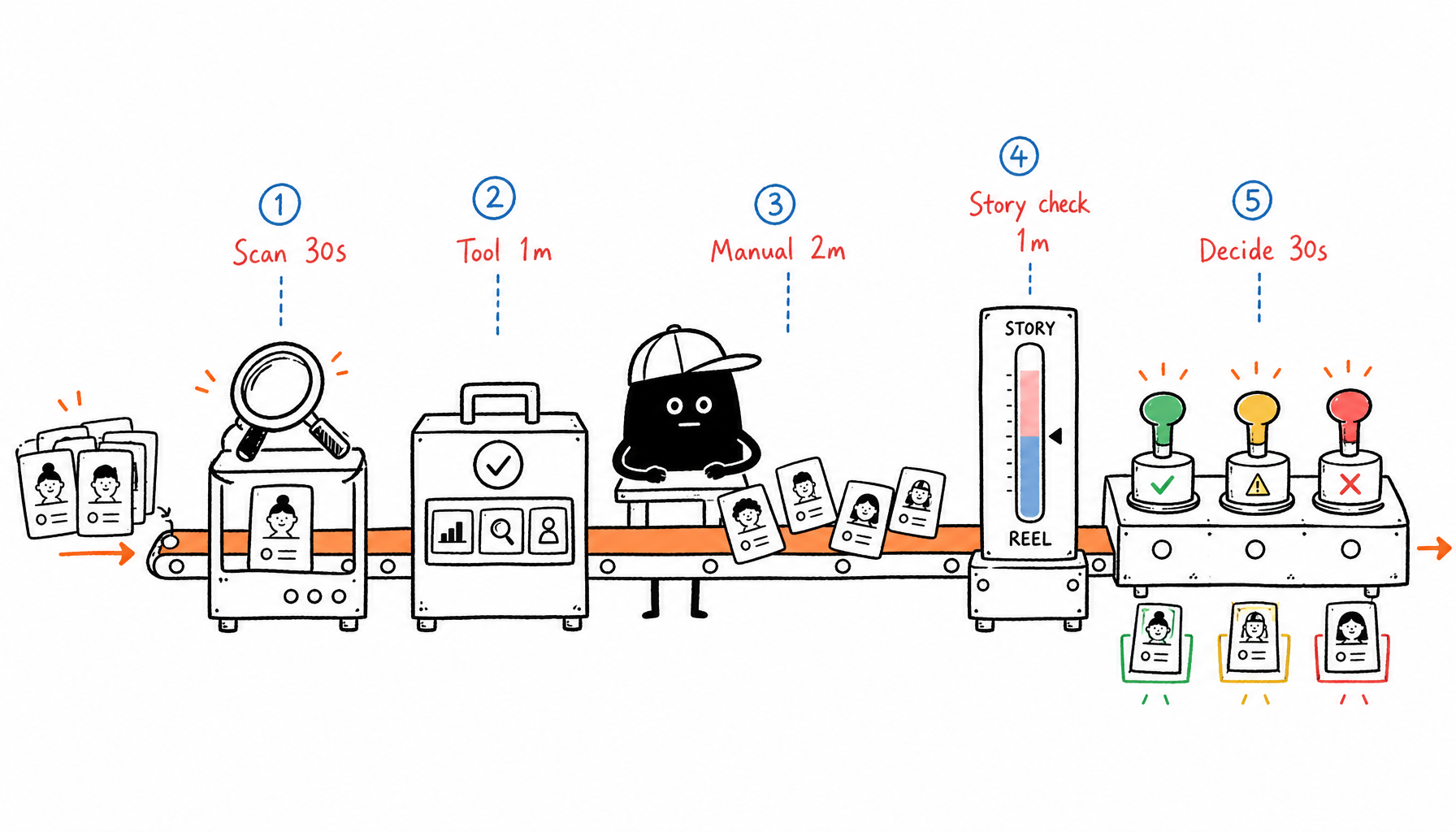
This workflow catches 90% of fake follower problems in under 5 minutes per account.
Tools That Help (But Don't Replace Manual Checks)
Automated tools speed up detection, but they're not perfect. Use tools for initial filtering, then manually verify promising candidates.
Recommended tool combination:
- CreatiVault Fake Follower Checker (Free)
- Instant fake follower percentage
- Engagement rate calculation
- Follower quality scoring
- Works for Instagram and TikTok
- Social Blade (Free)
- Historical follower growth charts
- Spots sudden spikes from bot purchases
- Daily follower change tracking
- HypeAuditor (Paid, starting $299/month)
- Deep audience demographics
- Geographic breakdown
- Fraud detection scoring
- Best for agencies running 20+ campaigns/month
Why manual checks still matter:
Tools catch statistical anomalies, but they can't assess content quality or brand fit. A tool flags 18% fake followers—is that a deal-breaker? Depends on engagement rate, content quality, and how the real 82% aligns with your target market.
Plus, 2026's AI-generated bots evolve faster than detection algorithms. A bot that looks "real enough" to fool automated checks still fails the manual eye test (generic comments, stolen bio, overly perfect AI-generated face).
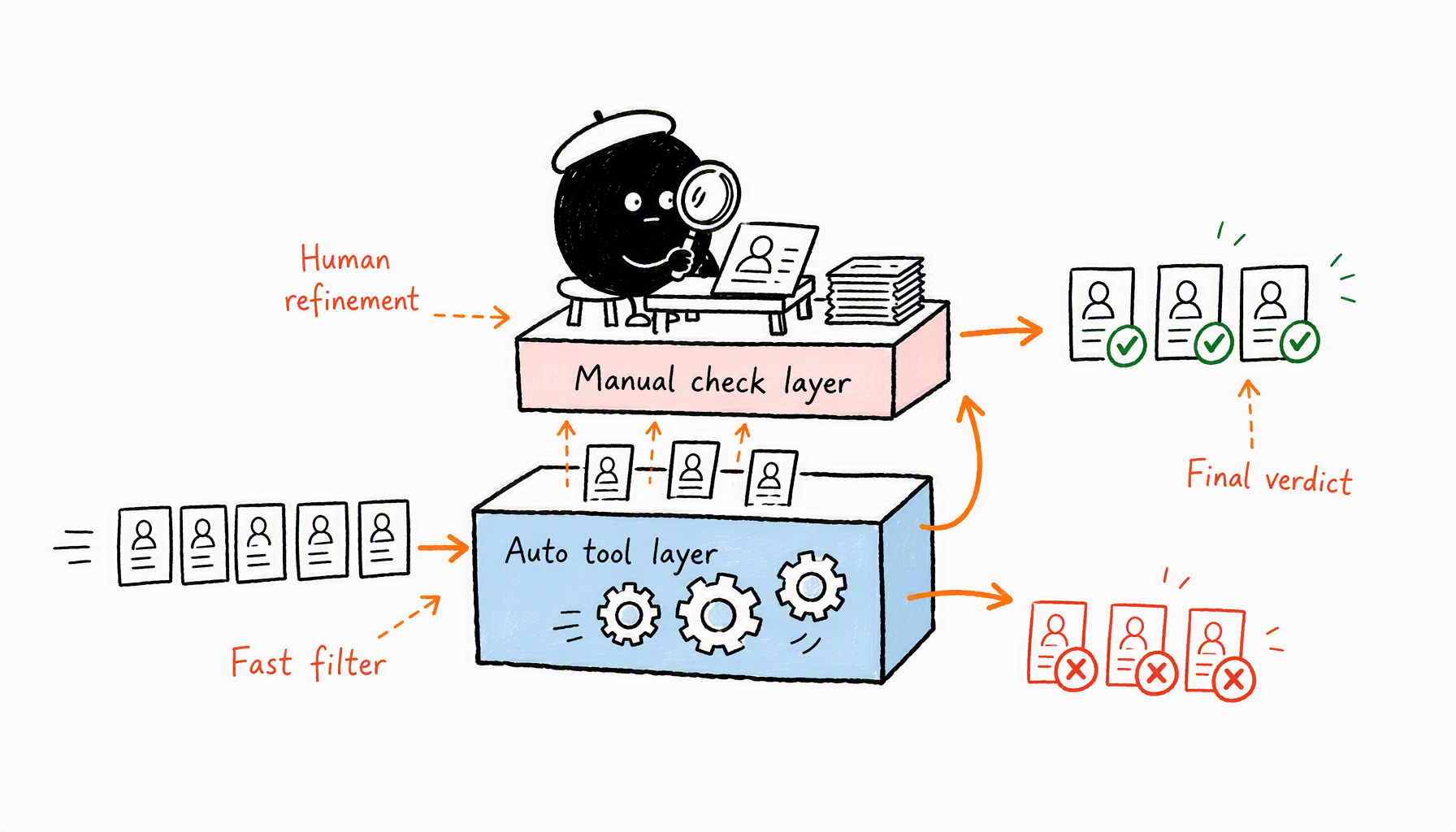
Best practice: Use tools for speed, confirm with manual checks for accuracy.
Conclusion
Fake followers aren't just vanity metrics—they waste real marketing budgets. A $5,000 influencer partnership with a 60% bot rate means you paid $3,000 for exposure that never reached real people.
7 red flags recap:
- Sudden follower spikes → Check growth curves for vertical jumps
- Low engagement rate → <2% is suspicious, <1% is almost certainly fake
- Suspicious follower profiles → AI-generated faces, empty bios, random usernames
- Generic comments → "Nice!" and emoji spam instead of real conversation
- Geographic mismatch → 70% followers from non-target countries
- Low Story views → Should be 5-15% of followers, not 1-3%
- Reel underperformance → Views below follower count exposes fake audiences
The 5-minute vetting workflow combines tool speed with human judgment. Run accounts through CreatiVault's checker, manually verify the top candidates, and cross-check Story/Reel metrics before signing any deal.
Next steps:
- Download the 7 Red Flags Checklist (free Notion template included)
- Run your next influencer shortlist through the checker—takes 30 seconds per account
- Bookmark this guide for your team's influencer vetting process
Ready to stop wasting budget on fake followers? Start with CreatiVault's free Instagram checker—instant authenticity scoring, no credit card required, unlimited checks.
Have questions about fake follower detection? Check out our [complete free tools library](https://creativault.ai/free-tools/) for TikTok fake follower checking, engagement rate calculators, and influencer vetting checklists.